
BEFORE YOU MAKE THE MOVE
The Malta Dream Has a Price. Know It Before You Move.
Sunshine, the Mediterranean, an English-speaking lifestyle and enticing tax advantages. It's easy to fall in love with Malta. But eight uncomfortable realities could turn your dream relocation into an expensive mistake.
Imagine making the move you've dreamed about for years. You've packed your belongings, signed a lease and left your old life behind. The Mediterranean is on your doorstep. The sun is shining. Everything seems perfect. Then reality arrives: the traffic outside your apartment barely moves, construction begins next door, your electricity bill isn't the problem but your rent is, and the tax advantage you built your future around turns out to have conditions you hadn't fully understood. Malta can be an extraordinary place to live, but falling in love with the island is not the same as making a successful move. Its drawbacks are real, measurable and, in some cases, financially significant. Crowded neighbourhoods, expensive housing, low local salaries, healthcare requirements and potentially time-limited tax benefits all deserve your attention. None of them automatically means you should abandon the dream. What matters is knowing which ones will affect you, how much they could cost and whether the life waiting for you in Malta is worth the trade-offs. Here are the eight realities every serious prospective resident should understand before committing.
1. Paradise Gets Crowded When Everyone Wants a Piece of It
Close your eyes and picture a Mediterranean island. Perhaps you see quiet streets, open countryside and little villages where time seems to stand still. Now open your eyes to Malta's reality. According to Eurostat, 588,254 people lived across Malta's three inhabited islands on 1 January 2026. Eurostat recorded a population density of 1,817 residents per square kilometre in 2024. That's more than three times the density of the Netherlands, the EU's second most densely populated country at 530. Germany stood at 236, and Austria at 111. Malta occupies a geographical category of its own. The concentration of people is extraordinary, and so is the pressure it places on the available space.
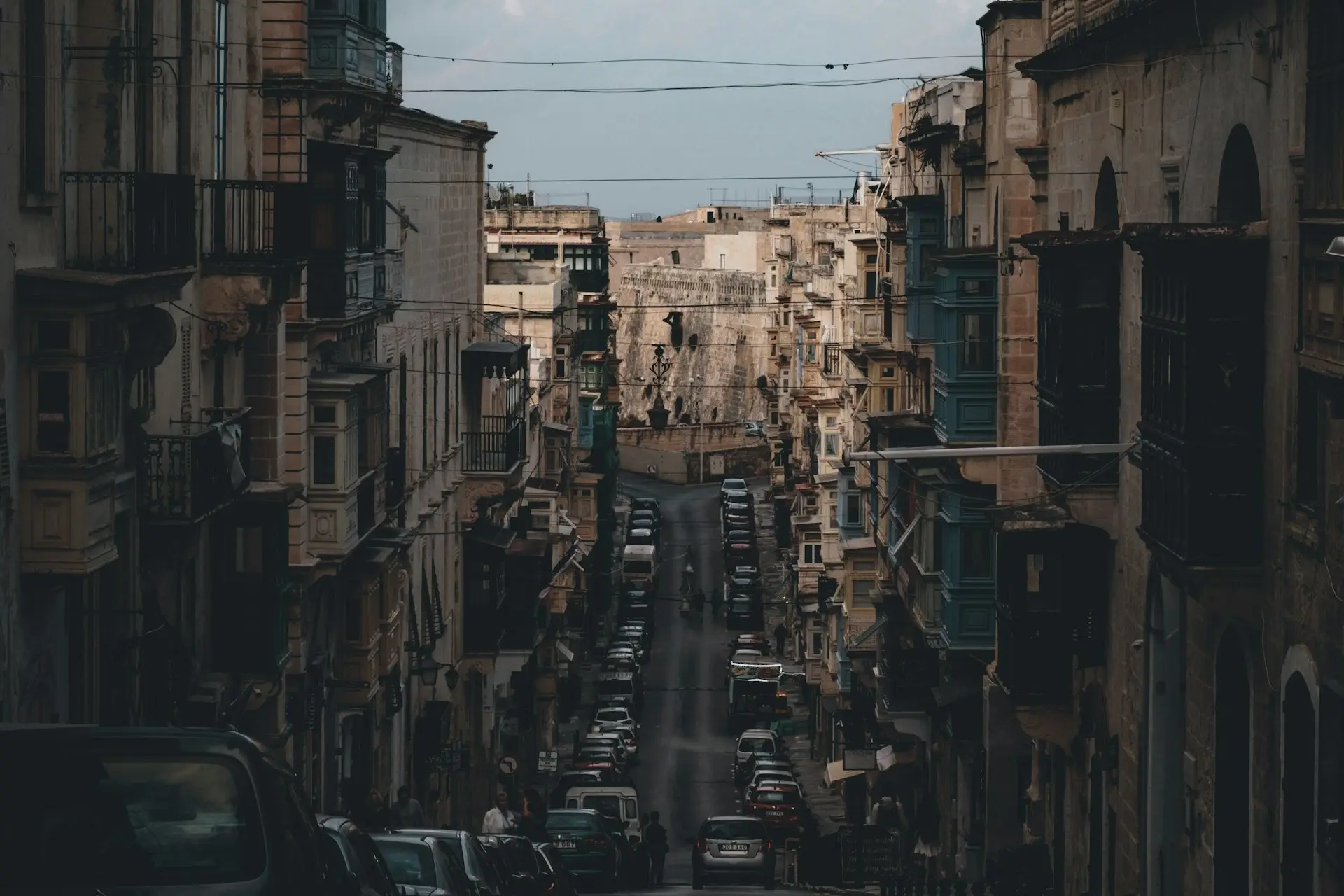
You'll feel that density when walking through the coastal communities stretching from Sliema through St. Julian's to St. Paul's Bay. One town often blends into the next. Open land is scarce, and an older house demolished today may be replaced by a taller apartment building tomorrow. Building sites, dust and construction noise can become part of the soundtrack of daily life. If you're accustomed to a quiet village, a large garden or the luxury of open landscapes, this may be the island's most difficult adjustment. There are quieter alternatives in the south, the interior and on Gozo, but choosing them can mean longer journeys to offices, schools and the airport. The question isn't whether Malta is beautiful. It is. The question is how much personal space you need to feel happy.
2. A Ten-Minute Journey Can Steal Your Morning
One of Malta's great attractions is its size. Everything looks wonderfully close on the map. But here's the catch: short distances don't guarantee short journeys. At the end of June 2026, Malta's National Statistics Office recorded 463,734 registered motor vehicles, almost three-quarters of them passenger cars. During the second quarter of 2026 alone, the net increase was 3,086 vehicles, averaging 34 additional vehicles every day. Against a population of roughly 588,000, that's almost eight registered vehicles for every ten residents. And they're competing for space on an island where the roads cannot simply expand indefinitely.
Picture your daily routine. You live in Sliema, work in Birkirkara and expect the journey to be easy because the distance looks so small. Then you discover what rush hour really means. Traffic builds, parking becomes a daily challenge and a simple commute starts consuming time you'd rather spend enjoying your new life. Many experienced newcomers avoid this by deliberately choosing accommodation close to their workplace or their children's school. Buses offer an alternative, but they share the same congested roads and cannot replace every journey. Where you live matters just as much as what you pay for your home. Get that decision right and Malta feels wonderfully convenient. Get it wrong and you may find yourself spending far too much of your Mediterranean life staring at brake lights.
3. Everyone Wants the Sea View. The Rental Market Knows It.
There's a moment during almost every Malta property search when the dream meets the budget. You've found the perfect apartment in Sliema, perhaps with a balcony, modern interiors and the Mediterranean within walking distance. Then you see the monthly rent. According to Malta's Housing Authority, rents on contracts registered in the first half of 2024 increased by 6.8% year on year. 41% of new long-term rental contracts exceeded €1,000 per month. The median monthly rent for a two-bedroom apartment in Sliema was €1,300, rising to €1,600 for a three-bedroom apartment. The most expensive areas include Sliema, St. Julian's and Swieqi, while many locations on Gozo offer substantially lower rents. Malta may be geographically small, but the difference between neighbourhoods can be enormous.
The uncomfortable truth is that the places many international newcomers find most appealing are also the places where competition drives prices higher. Waterfront cafés, coworking spaces, restaurants, international neighbours and an energetic social scene all come with a premium. Move farther inland or to a quieter community and your money may buy considerably more space, but you'll need to factor in the traffic and travel time you've just read about. Buying a property introduces a different set of considerations, including Malta's Acquisition of Immovable Property (AIP) permit rules. Before falling in love with a particular address, understand which purchasing rules apply to your status. Choose your home with your heart, but choose its location and financial commitment with your eyes wide open.
4. Malta Rewards International Income. Local Salaries Tell Another Story.
This is one of the most important distinctions you can make before moving. Malta can be financially attractive when you bring an established business, international clients, investments or retirement income. But arriving with the expectation of finding a well-paid local job is an entirely different proposition. According to Eurostat, Malta's statutory minimum wage in the second half of 2026 was €994 per month, compared with €2,343 in Germany. These are minimum wages, not average salaries, but the gap reveals something important about where the local pay scale begins. And remember that the median rent for a two-bedroom apartment in sought-after coastal communities can exceed the entire monthly minimum wage. A Mediterranean lifestyle can become financially uncomfortable very quickly when your income depends on the local employment market.
Then comes the taxation. A salary earned from a Maltese employer is Maltese-source income and is subject to Malta's normal income tax rates. Under the MTCA's single-person tax schedule, the rate is 0% up to €12,000, followed by bands taxed at 15% and 25%, reaching 35% from €60,001. The favourable Non-Dom treatment associated with Malta relates to qualifying foreign income, not ordinary Maltese employment income. This is why the country's financial appeal can be so different for an international entrepreneur, remote professional with foreign clients, investor or retiree than for someone seeking local employment. Before you ask what Malta will cost you, ask where your income will come from. That single question can change the entire financial outcome of your move.
5. The Island Can Be Affordable. Your Lifestyle Might Not Be.
Imagine your first few weeks in Malta. Breakfast overlooking the sea, lunch at a waterfront restaurant, a taxi home in the evening and perhaps a weekend flight to somewhere else in Europe. It's easy to slip into a holiday rhythm when your surroundings feel like a holiday destination. But a lifestyle that feels affordable for one week may look very different across twelve months. According to Eurostat, Malta's overall consumer price level in 2024 was 93.1% of the EU average. For comparison, Germany stood at 109.1%, Austria at 119.7% and Switzerland at 184.3%. On an overall price comparison, Malta can look attractive. But averages don't pay your monthly bills. Your actual spending depends on the home you choose, where you shop and how often you enjoy the island's restaurants and services.
Prices also change. Malta's NSO recorded inflation of 2.4% in September 2026, driven particularly by restaurants and accommodation, food and transport. Those are precisely the categories that can dominate an international newcomer's lifestyle budget. Dining out frequently, maintaining a car, choosing a desirable coastal address and travelling regularly can erode the savings you expected to make. Imported groceries are another factor worth considering. The real financial advantage of Malta may come less from cheaper everyday living and more from the money you could retain after tax, if your personal circumstances qualify. Run the numbers for the life you actually want to lead, not an imaginary version in which every day is affordable simply because the sun shines.
6. Your New Life Needs More Than a Passport and a Plane Ticket
The excitement of moving abroad makes it tempting to focus on the apartment, the weather and the new routine. But legal residence comes with practical requirements, and healthcare is one of the most important. For EU and EEA nationals, the right to live in Malta comes with a registration requirement when staying longer than three months. Applications are handled through the Identità Expatriates Portal, with appointments for biometric data arranged within 48 working hours according to the authority's stated procedure. The resulting document is generally valid for five years. For British, American, Canadian, Australian and other non-EU nationals, different immigration and residence requirements apply, and eligibility must be established under the appropriate route before planning a long-term stay.
For EU and EEA nationals who are not working in Malta and intend to support themselves through their own resources, Identità requires evidence of sufficient financial means, at least matching the relevant Maltese social-assistance threshold, together with comprehensive healthcare cover in Malta or an appropriate S1 certificate from the home country's healthcare system. An S1 may be available where someone remains insured in another eligible country, for example under certain employment arrangements. Without it, suitable private insurance must provide comprehensive cover from the time of registration. Healthcare is far too important to leave until after you've arrived. Establish how you'll be covered, what your residence category requires and which documents you need. The goal is to arrive ready to enjoy your new life, rather than discover that a missing insurance arrangement has put your residence plans on hold.
7. The Tax Advantage That Could Disappear When You Least Expect It
For many internationally mobile people, this is the reason Malta first appears on the radar. The possibility of living in a beautiful, English-speaking EU country while benefiting from favourable treatment of foreign income sounds almost too good to be true. And for someone who qualifies and structures their affairs correctly, the advantages can be substantial. But Malta's Non-Dom regime has rules that deserve just as much attention as its benefits. Misunderstanding them can turn an attractive financial plan into an expensive disappointment. There are two particularly important considerations: the annual minimum tax and the consequences of obtaining permanent residence documentation.
The €5,000 annual minimum tax. A person who is ordinarily resident but not domiciled in Malta may benefit from taxation of foreign income on a remittance basis. In simple terms, qualifying foreign income is generally taxed when brought into Malta rather than automatically being taxed in full. But this treatment has an important limitation. Where foreign income reaches at least €35,000 and is not fully remitted to Malta, Article 56(27) of the Income Tax Act provides for a minimum annual tax liability of €5,000 under the relevant conditions. If you've been imagining a completely tax-free Mediterranean lifestyle, that figure deserves your attention from day one. Your financial plan should reflect the actual rules applicable to your income and residence status, rather than an attractive headline about zero taxation.
The permanent residence trap. EU citizens who have genuinely and continuously lived in Malta for at least five years can qualify for permanent residence documentation, generally valid for ten years. That sounds like a welcome milestone. Yet Malta's Income Tax Act contains a critical rule dating from 2018. Under Article 4(1), the remittance-basis treatment and the exemption for foreign capital gains cease to apply once the relevant permanent residence certificate or card has been issued, with the change taking effect from the year of issue. The distinction matters enormously: a right to permanent residence and the issuance of documentation are not details to overlook in a long-term tax plan. If your entire financial future is based on enjoying Non-Dom treatment for ten or twenty years, understand this rule before making commitments that depend on it. The corresponding permanent residence route also differs for certain nationalities, including Swiss citizens under the applicable agreement.
Your former country may still have a claim. Malta's tax rules are only one half of an international relocation. The country you're leaving may continue taxing certain income, apply special departure provisions or treat you as resident if you retain significant connections. This is particularly important for anyone with businesses, investments, property or ongoing income in another jurisdiction. The consequences depend on your nationality, previous residence, income sources and the laws and treaties involved. The greatest tax advantage is the one that survives scrutiny in every country concerned. Before moving, work through the Maltese rules and the obligations that may follow you from home. Saving money is exciting. Building a tax position that remains defensible is what makes those savings genuinely valuable.
8. The Paperwork Nobody Dreams About. But Everybody Has to Face.
No one lies awake dreaming of residency applications, insurance arrangements and tax registration. You dream of the moment you unlock the door to your new home and realise you've actually done it. But getting there involves administration on both sides of the move. In the country you're leaving, you may need to clarify your residence status, deal with property and tenancy arrangements, review insurance policies, close or transfer contracts and establish whether keeping a home could preserve tax-residence connections. In Malta, you'll have to arrange the appropriate residence registration with Identità, obtain a tax number where required, organise banking and secure accommodation. The good news is that Malta handles these matters in English. The challenge is ensuring everything happens in the correct sequence. That becomes especially important if you're also establishing or relocating a company, changing where you earn income or coordinating residence and taxation across several countries. A successful move isn't simply the day you arrive in Malta. It's the day your personal, financial and legal affairs fit together properly in your new home.
The Real Question: Are Malta's Drawbacks Worth the Life You Could Gain?
Look at everything you've just read. Crowded neighbourhoods. Heavy traffic. Expensive apartments. Modest local salaries. Healthcare requirements. Tax advantages with important conditions. None of these realities disappears because the Mediterranean looks magnificent at sunset. Yet here's what makes Malta so compelling: the same disadvantages can matter enormously to one person and barely at all to another. If you're bringing international income, enjoy an energetic urban environment, can accommodate the potential €5,000 annual minimum tax and understand how permanent residence documentation could affect your Non-Dom position, the benefits may comfortably outweigh the inconveniences. You could be exchanging an expensive, high-pressure lifestyle for sunny mornings, a compact international community and a potentially more rewarding financial future. But if you need extensive green space, depend on a local salary or require a tax arrangement guaranteed to continue unchanged for decades, the same island deserves a much more cautious assessment.
Don't move to Malta because someone showed you a beautiful photograph or promised you a spectacular tax rate. Move because you've discovered exactly how your life would work here. Choose the neighbourhood you'd actually enjoy. Check the rent you'd really pay. Calculate how your income would be taxed, what healthcare would cost and how your residency status would develop. And before making the final decision, experience the island through the eyes of someone considering a permanent move. From 26 to 28 April 2027, join Sebastian and Sabrina in St. Julian's for a three-day Malta seminar. Visit Valletta and Gozo, inspect properties with a local estate agent and explore what residence, Non-Dom treatment and minimum tax could mean for your circumstances. Your companion can come free of charge. Three days of seeing the real Malta could help you avoid years of regret, or give you the confidence to finally begin the life you've been dreaming about.